
The Weight Being on Hold Held
Or, the clues you lose when voices vanish

Three weeks after promising that these essays would open weekly windows onto a nugget of natural habitat, you the reader are still waiting for our first visit to a park. That’s coming: today, we’ll pause on the metaphor we use for that unfulfilled state.
My best hope is that you feel “left on Read:” those of you who subscribed to or supported the Substack haven’t seen the whoosh across your screen you were expecting. When I was growing up, the metaphor would have you “left on hold.” My silent early-morning run through downtown Phoenix last December brought that metaphor tumbling back to the foreground. The picture below shows the cue.
And if we poke around, we’ll find loamy soil in those metaphors.
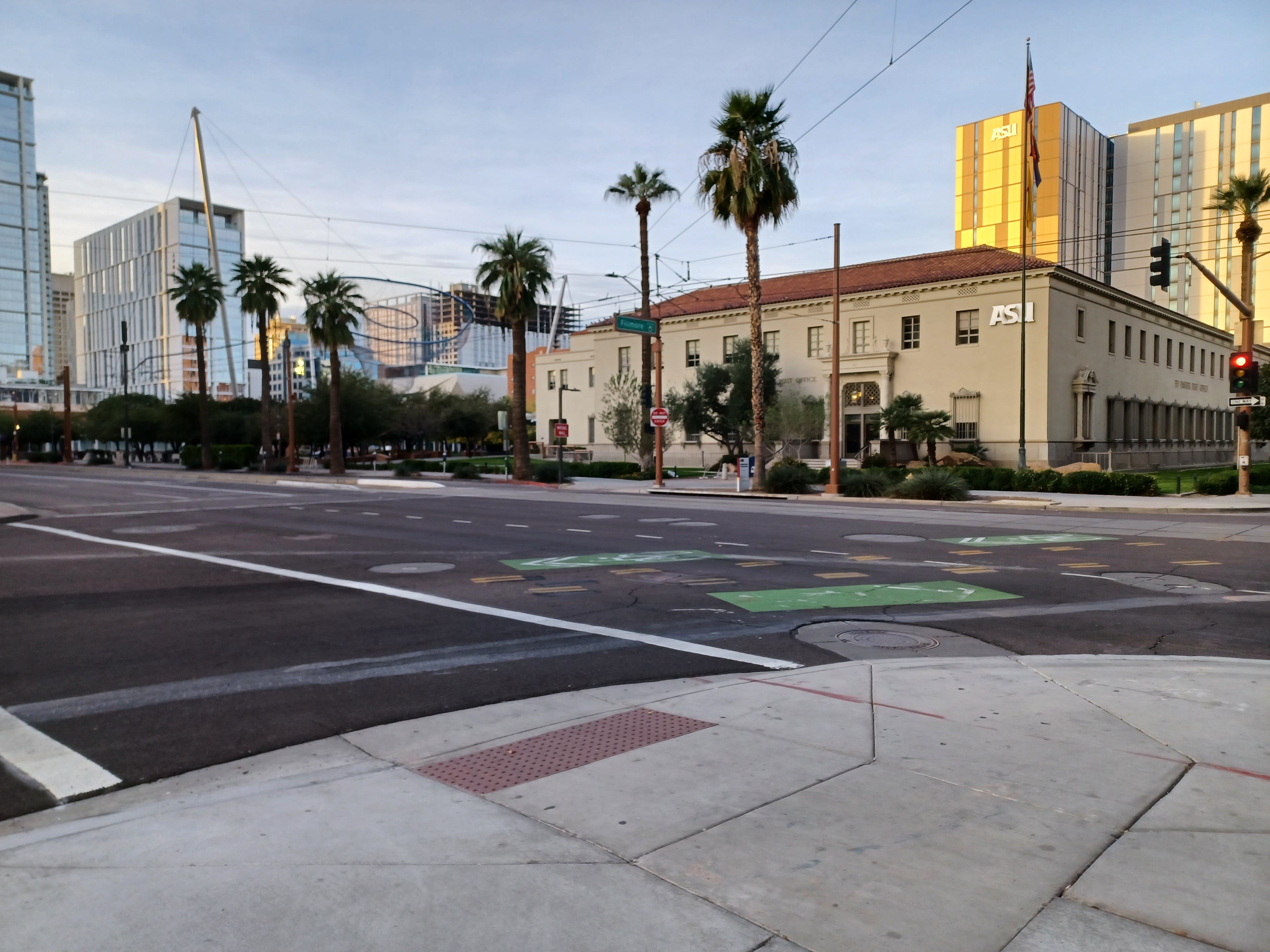
An urbanized world where ideas and requests traveled over telephone wires dealt a lower volume of information to anyone at any node. However, each ingot of information weighed more than it seems to now. If you lived in, say, Phoenix in the 1980s, the wires above would have crackled with occasional check-ins to relations in other time zones and frequent requests. If you wondered where your late W-2 might be or what time you needed to turn in the projections for the O’Shaughnessy account, you would call someone and the answer would come into focus with notable speed.
That’s notable, not instant. You had to tough it out while answers rose from the mist. As a result, you sensed the work going on. The manager might have put the phone down: you might have heard her walk over to a file cabinet, open a drawer, tap a pen to her ear. She would come back and pick up her phone: “Got it.” Learning felt more like sharing shovels on a dig, less like catching facts in a bucket.*
And waiting to learn over a phone line carried the sense of mustering, rather than of mooring or meandering. My father worked with someone who once quipped: “While I’m on hold, why can’t I talk to the other people on hold?” (In a way, he was foreshadowing social media.) You anchored to the maybe-dull, perhaps-nerve-wracking task before you. Maybe you doodled. If the person on the line couldn’t resolve it then, the person would call you back. You would tighten your focus again.
Oh, and when you were away? Well, then, that’s where you were.
When people discarded calling (and holding) for texting, conversation uncoiled. Sometimes it stretched so far that it broke. A friend might ask: what time are we meeting? Hours can melt away before the other friend answers: rnow. In the window between the messages, Forgetful Friend A moved through the world with flimsier assurance, a little less grounding, more fleeting ideas or images claiming attention.
When you look at it that way, Friend A wasn’t waiting at all. Friend A might have forgotten forgetting about what time the friends were meeting. Some similar diffusion happens in work exchanges. I might ask you to help me find a form, and when you tell me where you think the form is I may have formed some other mess. And somewhere in there, every commitment becomes lighter and loses some solvent power.
That’s true, too, of humans’ commitment to choose wise paths of living together with other life. If we condition ourselves to say what we want to say in a blurt, drift to other things, and get the answer from somewhere else in the world whenever we happen to get it, then the idea of anchoring into a system of flows where we all depend on each other becomes pretty dilute.
It becomes dilute, that is, unless people make a point of strengthening it.
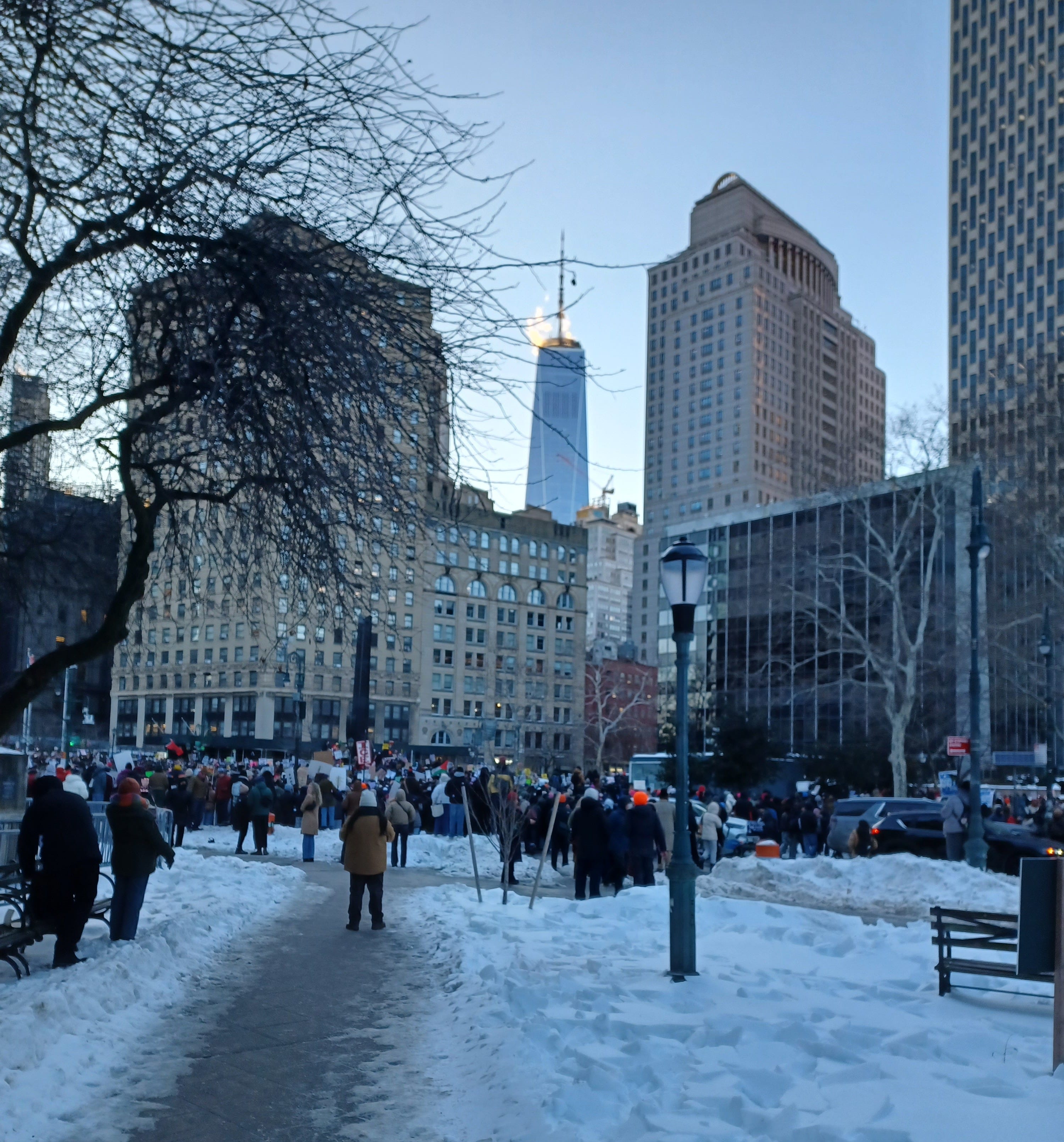
Political action these days mixes the micropersonal with the fundamental. At protests like the one you see above, most signs and chants anchor to a specific outrage (in this case, federal thugs murdering American citizens for defending their neighbors). At huge events like this past Saturday’s No Kings, the complaints on the posters ranged like aphids. In my little cluster, people’s signs objected to having gray hair and not being at home with one’s cats - along with more communal grievances against Trumpian hate and grift. Mass protests have always brought out indignados across the spectrum, but some of these signs seem so individual that they might as well be texts. I had to wonder if the people hoisting them expected any attentive reply.
Targeted, sustained political action echoes the logic of being on hold: it brings people together, works out questions and answers, pauses, resumes, and takes stock of progress. Political fury helped bring us each Trump presidency. In many minds, I would bet it combines with a despair of ever being heard.
Committing to building up your neighborhood’s parks or welcome your neighborhood’s refugees, or electing people who protect women’s rights, will all gain both heft and gleam with conversation. People in sustained civic projects act in concerted schedules (think about canvassing and campaigning), and follow up on loose threads. Of course, they also text and Slack and DM and post, and oftentimes a random meme or recipe will surface. But the intention honors focus and devotion.
One advertised virtue of the morph from a culture on hold to a culture on Read involved unshackling. A series of ads for AT&T from the year I graduated college anchored to the tagline “You Will,” promising among other graces that I would be able to send a fax from the beach. (Someone has archived these ads here, and while I can’t vouch for their accuracy the first one sure looks familiar.) It seemed kicky then.
But what the ad’s creators didn’t know or didn’t divulge was that there’s spine-fortifying value in waiting to send the fax (call it a Slack or PDF) until you leave the beach. It glossed over the merit of noticing that the beach keeps getting smaller from a higher sea level, that fewer folks have shown up because they’d just as soon not expose themselves to germs, that hardly anyone can scratch together the cash to pay for a week at the beach. If you had to think only about the fact that you were offloading work from the beach, you might reckon with more discomfiting things.
It’s also a lot easier to enjoy the beach without the O’Shaughnessy account needling you. Another argument for thinking in terms of hold rather than Read is that this kind of thinking makes it clearer and more cathartic when you’ve let go.
All of which leads me to re-up my promise. These essays work as an open window into what I’m thinking about and hoping to write about in more dedicated space. I intend to soon ground them in visits to parks and other places where we can reckon with the pace and cost of climate change. And I hope that reckoning can reset some thinking to grapple with more complex choices across our virtual and real worlds.
Who knows? With some practice concentrating answers and questions in the same span of time, we might decide more lovingly what we really want to hold onto.
*The bud of instant-information had started its invasion. In New York at least, as early as 1980 you could call a number for a recorded rundown of sports scores, weather forecast, or even to find out what time it was.